

The Project
Guide to commercial, tourism, and cultural resources
Everything the municipality has to offer, brought together for the first time in one single place.
The Honourable City Council of the Villa of La Matanza de Acentejo is promoting the creation of a digital resource guide that brings together, in a single point of reference, the commercial offering of the municipality’s Open Commercial Zone, its tourist and cultural landmarks, the public infrastructures and services available to citizens, and the municipal cultural programme.
The project responds to a dual need. On the one hand, the difficulty faced by small local businesses in gaining visibility in an increasingly digitalised consumer environment, where the lack of an online presence limits their ability to attract new customers. On the other hand, the dispersion of municipal information regarding tourist, heritage, cultural and public service resources, which until now has been spread across different channels without a unified access point for residents and visitors.
The Guide
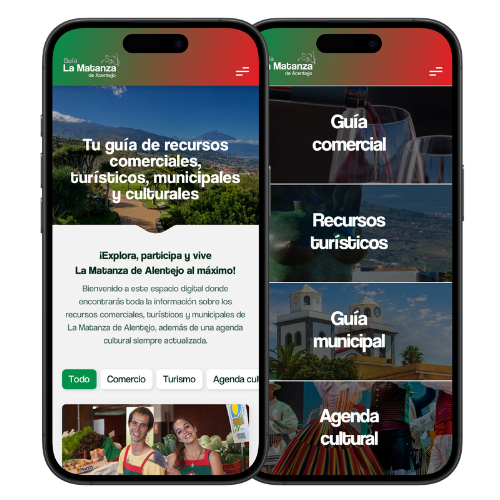
It is a multi-device web application, designed primarily for use on mobile phones and accessible through a direct link or QR code, without the need for prior download or installation. The Guide provides a global and comprehensive view of the municipality’s resources, geolocating them and linking them together, so that consulting any resource displays the nearest related resources, either due to geographical proximity or their proximity in the calendar.
The tool is also designed as a two-way communication channel between businesses and citizens: each establishment has its own access area to independently and freely manage its business information and publish products and offers, with specific training provided by the City Council.
Goals
- Increase the visibility and promotional opportunities of local businesses.
- Strengthen the direct relationship between businesses and consumers.
- Have an updated census of the commercial sector to facilitate the planning of business development initiatives.
- Provide citizens with geolocated access to public infrastructures and services.
- Provide visitors with a directory of tourist resources with content in Spanish, English and German, including audio narration for use as an audio guide.
The data generated is published in OPENDATA format, so that it can be integrated into regional initiatives such as Consume Canarias, the online commercial directory of the Canary Islands.

Smart Commercial Destination
The Guide is committed to municipal-scale digitalisation, designed around the real conditions of local businesses and aimed at strengthening them rather than replacing them. It is managed by the public sector, with no cost or intermediaries for businesses, and it is open to the participation of the businesses themselves, which retain control over their information and decide what to publish and when.
The information generated is also made available to citizens in a reusable format, ensuring that knowledge about the municipality’s commercial network remains a public asset.
It is not about bringing sales to the screen, but about bringing people to the counter.